Commercial · Baltimore, MD

Concrete Equipment Pads in Baltimore

Need a concrete base for installed equipment? Discuss equipment pads with Baltimore’s Concrete using the equipment’s weight, anchoring and placement requirements.

How this service can help
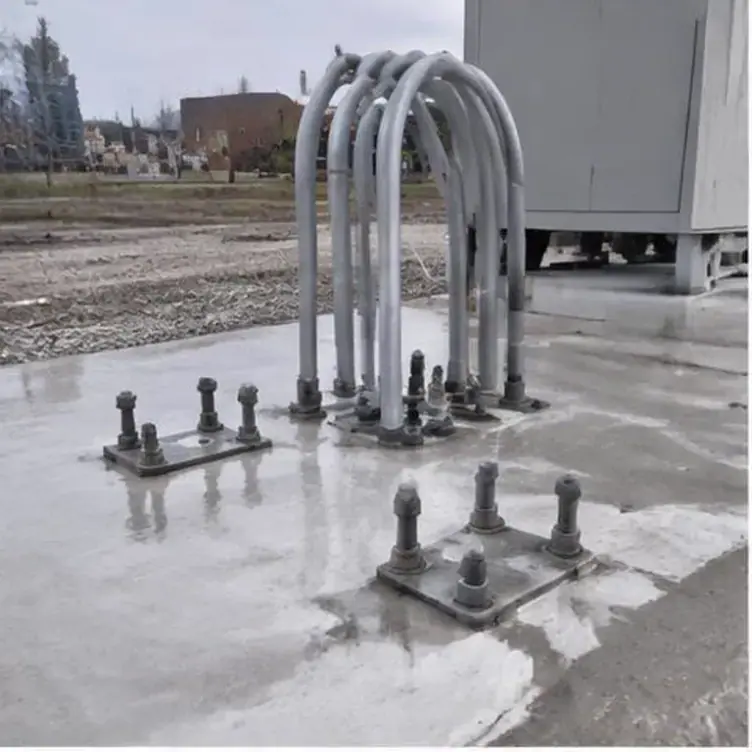
Equipment pad prepared with anchor bolts and conduits

Get an equipment pad scoped to the equipment

The pad must suit the size and weight of the unit it will hold. Baltimore’s Concrete offers concrete equipment pads planned around that unit, the site and the work needed to install it.

Bring the unit’s plans before choosing a slab size. We need to know its weight, fixing points and service lines. Leave room for people to reach it for checks and repairs. Share the proposed spot and the maker’s instructions so the pad can be planned as part of the full job, not just a flat square of concrete.
Bring us your commercial concrete scope.

Describe the intended use, project size and access requirements. Mention operating hours, other trades and scheduling constraints that the proposed scope needs to account for.

Your concrete equipment pads options

Unit sizes, weight and anchoring needs help define the pad scope. Share manufacturer or project details so the proposed work is not based only on the visible size of the equipment.

Equipment delivery, maintenance access and nearby utilities can influence the pad location. Include these limits in the discussion before the location and concrete boundaries are finalized.

A current pad may need removal before a replacement can be placed. Find any surrounding pavement, drainage or service work that needs planning so responsibilities are clear in the estimate.

Match dimensions and clearances to the equipment

Manufacturer details can define sizes, weights, anchor locations and service clearances. Utility equipment may have extra needs from the relevant provider. Bring those documents into the estimate discussion so the pad footprint and connections are based on the unit and the space needed around it.

Generator pads may also need to accommodate an integral fuel tank and spill containment, which changes thickness and edge details.

Coordinate anchors, sleeves and service openings

Anchor bolts, housekeeping pad dowels, and conduit or piping stub-ups must land exactly where the equipment needs them. Templates provided by the supplier or electrician are set before the pour. A conduit coming up a few inches off position can mean an awkward field fix or cutting the new pad.

A pre-pour check with the electrical or mechanical contractor confirms every penetration is in place and capped against concrete intrusion.

Identify vibration and isolation requirements

Rotating equipment transmits vibration into whatever supports it. Pads are frequently isolated from nearby slabs or building walls with expansion material so vibration and noise do not travel into occupied spaces. For larger machines, the engineer may specify thickness or mass needs for vibration control.

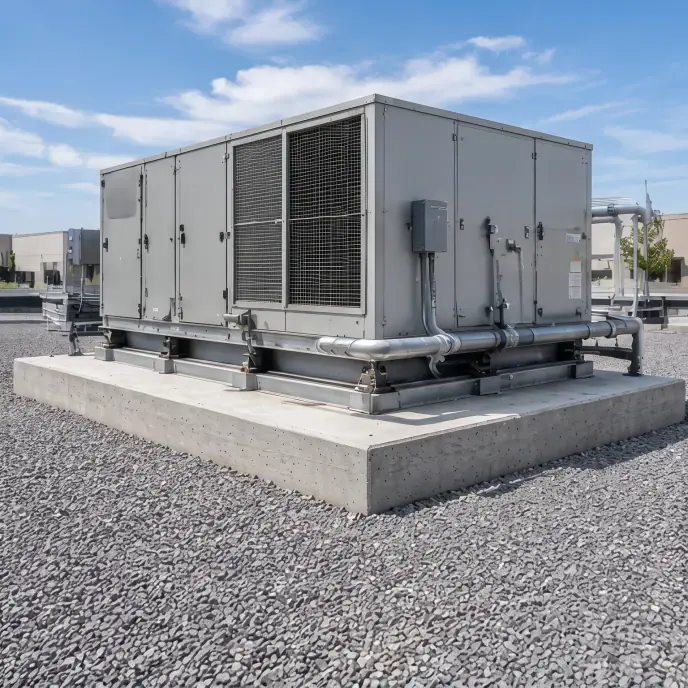
Commercial HVAC equipment mounted on a concrete pad
Your project, your next step

Match the concrete pad discussion to the equipment specifications and installation setting.

Include drainage and surrounding protection

Outdoor pads are set slightly above surrounding grade and sloped so water drains away from equipment bases. Gravel borders, bollards near drive lanes, and screening may be part of the scope. Pads near parking areas benefit from protection against vehicles backing into expensive units.

Plan around the equipment installation

Concrete needs time to gain strength before a crane sets a heavy unit on it, so pad placement is scheduled well ahead of equipment delivery. Planning that timing with mechanical and electrical subcontractors avoids a crane crew arriving to find a pad that is too green to load.

Prepare a stable base beneath the pad

A pad is only as level as the ground beneath it. Topsoil and loose fill are removed, and the base beneath the pad is prepared and compacted for the soil found on site so the pad does not tilt as seasons change. Pads beside foundations sit over backfill that may continue settling, so deeper excavation or extra compaction is common in those locations. A tilted condenser or generator can stress refrigerant lines, fuel piping, and electrical connections long before anyone notices the slope. Checking the finished pad with a level before the forms are stripped confirms the surface is true, which spares the mechanical installer from shimming every foot of the unit.

Your concrete equipment pads estimate: what changes the scope

Equipment pad estimates depend on sizes, loading needs, reinforcement, anchoring details and access. Removal of an old pad, excavation and planning around current services can add work. Clarify equipment handling and installation responsibilities, including any temporary support or service interruption handled by others. The concrete pad proposal should be compared against the same equipment specifications.

Request an estimate for concrete equipment pads in Baltimore

Contact Baltimore’s Concrete with the address, equipment specifications and photos of the proposed location. Include the required sizes, current surface and any schedule tied to the equipment installation.

Make your next step count

Planning concrete equipment pads

Provide the unit specifications and proposed location, discuss anchoring and service access, and clarify removal and preparation before the pad is planned.

Details that shape your scope

  1. What equipment will sit on the pad?

  2. Does a utility company have pad needs?

  3. When is the equipment delivery scheduled?

Related work

Often planned alongside

Questions & answers

Equipment pad questions

Thickness depends on equipment weight, anchoring, and any engineer or utility needs. The equipment submittal is the starting point.

A pad cannot take the equipment until it is strong enough for that weight. Generators and transformers are set on a schedule agreed with the engineer, supplier, and utility, not on a fixed number of days.

The equipment manufacturer, mechanical contractor, or electrician often supplies templates or drawings for anchors and stub-ups.

Read: Coordinate anchors, sleeves and service openings

The equipment usually must be disconnected and lifted. Planning that with the equipment owner and service contractor is part of the plan.

Start your project

Request a commercial concrete estimate.

Discuss your property’s concrete needs with Baltimore’s Concrete, including the space, access and intended use.